

Turn around and look behind you.
How far did you turn?
Did your shoulders move freely? Did your hips join the movement? Or did your body stop early and quietly convince you that was as far as you needed to go?
That stopping point might not feel like pain yet. It may feel like stiffness, tension, hesitation, pressure, or the sense that pain is waiting just beyond the movement.
That is what I call the edge of pain.
It is the boundary between the movement your body currently accepts and the movement it has begun protecting.
We encounter that edge all day long.
It appears when we turn to back up a car. When we reach overhead. When we bend down. When we squat. When we get off the floor. When we rotate through our hips or try to look behind us.
Most of the time, we do not stop and investigate it.
We simply move around it.
The Edge Can Quietly Move Closer
When a movement feels uncomfortable, the natural response is to avoid it.
We turn a little less.
We bend a little less.
We stop getting on the floor.
We use our arms to push ourselves out of a chair. We rotate our entire body instead of turning through the neck, spine, and hips. We create new ways of moving around the places we no longer trust.
At first, these adjustments seem harmless. The body is remarkably good at finding another route.
But when we repeatedly avoid a range of motion, we stop giving the body experience inside that range. The edge may begin appearing earlier, and our available world of movement can gradually become smaller.
Research into persistent musculoskeletal pain describes a related pattern called fear avoidance. When movement is repeatedly associated with pain or threat, people may begin avoiding that movement, which can contribute to reduced activity and function. Graded exposure reverses that pattern by carefully reintroducing movements that have become feared or avoided.
The edge of pain does not always arrive with a dramatic injury.
Sometimes it creeps.
One degree at a time.

Train the Edge Instead of Waiting for It
Training at the edge of pain does not mean driving yourself into pain.
It means intentionally approaching the place where your body first begins to resist.
You move slowly enough to notice it.
You stay controlled enough to listen.
You breathe.
You explore the position.
You may move slightly into the edge, slightly away from it, and then return. You are not trying to defeat your body. You are giving it useful information about a movement it has become uncertain about.
This is the difference between experiencing pain unexpectedly during everyday life and exploring its edge deliberately during practice.
One happens to you.
The other is something you study.

Your Range of Motion Is More Than Tissue Length
We often assume that limited mobility means a muscle or piece of fascia has simply become too short.
The reality appears to be more interesting.
Research shows that improvements in flexibility can come from more than one place. Stretching may change tissue stiffness, but it can also increase stretch tolerance, meaning the nervous system becomes more comfortable with the sensations experienced near the end of a movement. A large 2025 analysis found that repeated static stretching increased range of motion through a combination of reduced stiffness and improved stretch tolerance.
In a four-week study, researchers found that improvements in flexibility were largely connected to changes in how participants perceived and tolerated discomfort, rather than dramatic physical changes in the muscle-tendon unit.
That does not mean the changes are imaginary.
It means mobility is partly a conversation between the tissues, the nervous system, the brain, and the sensations being received from the movement.
Your body is not just measuring how far it can move.
It is also deciding how far it is currently willing to let you move.
Where Fascia Fits
Fascia is part of the connective-tissue network surrounding and connecting muscles and other structures throughout the body. It responds to load, position, movement, and time.
A 2024 study found that sustained static stretching temporarily reduced both muscle stiffness and deep-fascia stiffness in the calf. The researchers did not find the same stiffness reduction from the dynamic stretching condition used in that experiment.
Other research has found that mobility work can improve range of motion without always producing a large measurable change in tissue stiffness. For example, foam rolling has been shown to alter the perception of stretch and improve range while also affecting sliding between layers of fascia.
So when we train at the edge, several things may be happening together:
- The tissues are receiving load.
- The joints are experiencing a position.
- The nervous system is receiving new information.
- The brain is deciding whether the movement feels manageable.
- And we are learning where our body currently draws its boundary.
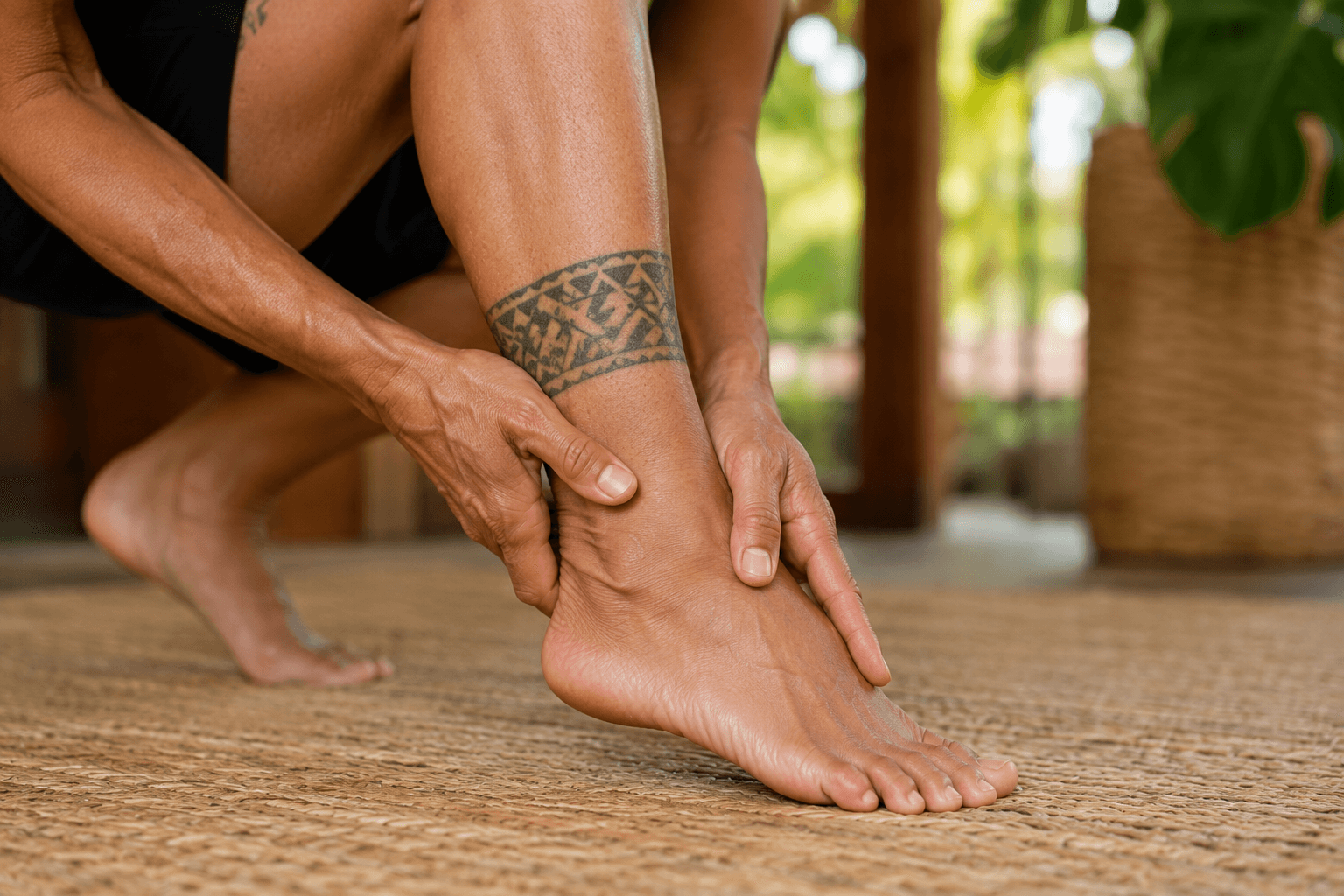
Pain Is Not Automatically a Stop Sign
Pain is important information, but it does not always mean that damage is occurring.
Research comparing painful and pain-free therapeutic exercise for chronic musculoskeletal conditions found that experiencing some pain during exercise did not prevent improvement. Painful exercise showed a small short-term advantage in that review, although neither approach was clearly superior over the medium or long term.
Stretching research also gives us a useful distinction. Stretching all the way to pain has not shown a clear advantage over stopping at strong discomfort. In one study, both approaches improved range of motion, but pushing to pain produced no additional benefit.
That supports the idea of training at the edge, rather than charging through it.
You are looking for the beginning of the boundary, not the highest amount of pain you can tolerate.

What Does the Edge Feel Like?
The edge may feel different from one person to another.
It might feel like:
- A strong stretch that demands your attention
- Pressure or resistance
- A guarded or hesitant feeling
- The first faint appearance of familiar discomfort
- A place where you naturally hold your breath
- The moment your body begins finding another way around the movement
Your job is not to assign the perfect number to it.
Your job is to notice it.
The edge should still allow you to breathe, remain controlled, and make choices. Sudden sharp pain, electrical sensations, rapidly increasing symptoms, loss of strength, or a movement that feels clearly unsafe is something different. That is not an edge to challenge during a general movement class.

A Simple Experiment
Choose a familiar movement.
Slowly rotate and look behind you.
Notice where the movement begins to feel restricted. Do not force farther. Pause near that point and take a slow breath.
Back away slightly.
Return to the edge.
Let your shoulders, ribs, spine, and hips participate instead of demanding all the motion from one area.
Repeat the exploration slowly.
Then return to the starting position and check the movement again.
You are not trying to manufacture a dramatic improvement in one attempt.
You are learning:
- Where does my movement stop?
- What sensation makes me stop?
- Do I hold my breath?
- Do I tighten somewhere else?
- Can I approach the same position with a little less protection?
That is the laboratory.
The Goal Is Not Pain
The goal is understanding.
The edge of pain is where your body begins revealing what it trusts, what it protects, and where it has learned to stop.
When we constantly avoid that edge, it may gradually move further into our everyday lives.
When we approach it with patience, control, and curiosity, we give ourselves an opportunity to reclaim some of that lost territory.
Not by forcing the body.
Not by ignoring its signals.
By finally paying attention to them.
Do not chase pain. Train at the edge of pain.