

When an Old Injury Still Feels Blocked
Imagine someone who hurt their back reaching into the trunk of a car.
At first, avoiding that motion makes perfect sense.
The tissue is irritated. The body stiffens. The person moves carefully.
Weeks pass.
The injury improves. Walking is easier. Daily life starts returning.
But that one reaching-and-rotating motion still feels blocked.
The person approaches the position and the body tightens before anything dramatic has happened. The breath shortens. The back braces. Range disappears.
It feels as if the tissue has reached its limit.
But what if the body is not measuring the tissue in that moment?
What if it is recognizing the situation?
Same angle. Same intention. Same old alarm.
That does not mean the pain is imagined.
It means protection can be learned.
Pain Is Not a Simple Damage Meter
The old picture of pain is a doorbell:
Damage happens at one end.
A signal travels up a wire.
Pain rings at the other end.
The real system is more complex.
Signals related to actual or potential tissue threat travel through nerves and the spinal cord. Along the way, those signals can be amplified, reduced, filtered, or influenced by other sensory input and by descending signals from the brain.
Gate control theory helped establish that pain processing is not a one-way trip from tissue to brain. The spinal cord and brain actively modulate incoming information. Theories of pain: from specificity to gate control · From the gate to the neuromatrix
Modern pain science makes another important distinction:
Nociception
The nervous system detects actual or potential tissue-damaging events.
Pain
Pain is a personal sensory and emotional experience associated with, or resembling that associated with, actual or potential tissue damage.
Nociception and pain are related, but they are not interchangeable. Pain can be strongly influenced by context, expectation, previous experience, attention, safety, fear, and meaning. IASP revised definition of pain
That is why the amount of pain does not always match the amount of visible tissue damage.
It is also why persistent pain should never be dismissed as fake.
Pain is real even when the protection system is contributing more than the original tissue injury.
The Body Learns Movements
A movement repeated often enough becomes easier to produce.
The nervous system does not rebuild every action from scratch. It learns patterns.
Walking.
Reaching.
Standing from a chair.
Swinging a golf club.
Performing an armbar.
Practice strengthens the pathways involved in producing and recognizing those actions.
This is useful. Without learned movement, ordinary life would require constant calculation.
But movement can also become associated with pain or threat.
If a certain rotation, reach, load, or position repeatedly hurts, the nervous system may begin protecting that pattern earlier.
The movement becomes more than a movement.
It becomes a warning cue.
The source chapter calls this a sensory engram — a learned trace connected to a movement and its history.
The practical idea is simple:
The body may remember the event before the tissue reaches danger.

The Brake Can Fire Before the Movement
A person does not always have to complete a painful action before protection appears.
Sometimes merely preparing to move is enough.
They think about bending.
Their back tightens.
They reach toward the floor.
Their breath changes.
They approach a staircase.
Their knee stiffens.
This can feel automatic because it largely is.
The nervous system is constantly predicting what is about to happen and preparing the body for it.
Predictive-processing models propose that perception is shaped by both incoming information and the brain’s expectations. Pain researchers are actively studying how prior expectations, uncertainty, context, and prediction errors may influence pain experiences. These models are useful, but they remain scientific frameworks rather than a complete explanation for every person’s pain. Predictive coding models for pain perception · Chronic pain and predictive processing
The Everyday Version
The nervous system is not waiting passively for the next accident.
It is trying to prevent one.
Sometimes that prediction is accurate.
Sometimes it is cautious.
Sometimes it keeps using an old forecast after conditions have changed.
Where Fascia Enters the Story
Fascia is part of the body’s connective-tissue network.
It surrounds and links muscles, bones, joints, nerves, blood vessels, and organs. It contributes to load transfer, sliding between layers, and sensory information.
Fascia is not just shrink-wrap.
Studies identify nerve endings within fascial tissues, including sensory and nociceptive fibers. Research also supports mechanical force transmission between neighboring structures through connective tissue, although the clinical meaning varies by region and task. Fascial innervation systematic review · Fascia and force transmission review · Thoracolumbar fascia and nociception review
This makes fascia relevant in two different ways:
Fascia Can Be Tissue
It can be loaded, irritated, injured, sensitized, or affected by scarring and disease.
Fascia Can Be Sensory Territory
Movement, pressure, stretch, vibration, tension, and position all create information that travels through the nervous system.
That does not mean every restriction is fascia.
It does not mean pain can be explained by one fascial line.
It means connective tissue participates in both mechanics and sensation.

The Body Map Can Become Less Clear
The brain maintains working maps of the body.
These maps help answer questions such as:
- Where is the body part?
- How is it moving?
- How much force is being produced?
- Is the movement familiar?
- Does this feel safe?
In some chronic pain conditions, researchers have found altered tactile acuity, motor imagery, or body representation. The findings are not identical across every condition, and the evidence is more consistent in some limb and facial pain conditions than in axial pain. Sensing the body in chronic pain review · Tactile acuity systematic review · Motor imagery meta-analysis
A fuzzy map does not mean the brain has forgotten that the body part exists.
It means sensory discrimination and confidence in the region may be altered.
When a body area feels vague, unpredictable, or threatening, people often guard it more.
The answer is not necessarily to stretch harder.
It may be to give the nervous system clearer, safer, more useful information.
Why Forcing the Wall Can Backfire
When someone reaches the point where their body applies the brakes, there is a temptation to push through it.
More force.
More stretch.
More pressure.
More determination.
Sometimes a body needs progressive exposure to load.
But overwhelming a protective response can confirm the very prediction a person is trying to change:
“I knew this position was dangerous.”
That is why dosage matters.
The goal is not to prove toughness.
The goal is to create a movement experience that is:
- Noticeable enough to teach something
- Manageable enough to remain organized
- Challenging enough to build capacity
- Safe enough that the body does not need to escalate protection
In graded-exposure approaches, feared movements are reintroduced progressively rather than avoided forever or attacked all at once. Research suggests graded exposure can reduce fear and disability for some people with chronic musculoskeletal pain, although it is not superior in every study or appropriate for every condition. Graded exposure randomized trial · Graded activity and exposure meta-analysis
The Useful Target
Do not fight the brake.
Give the system a better reason to ease it.
Memory Can Be Updated — but This Idea Needs Care
When a memory is recalled, it may temporarily become more open to modification before it is stored again.
This process is called memory reconsolidation.
Prediction error — a meaningful difference between what was expected and what actually happened — is considered one of the conditions that can help trigger memory updating. Memory reconsolidation and prediction error review
This creates an appealing rehabilitation idea:
A person expects a movement to be dangerous.
They approach it carefully.
The movement is completed within a manageable dose.
Nothing catastrophic happens.
The nervous system receives new information.
But the evidence does not justify saying that one safe repetition erases a pain memory.
Pain is influenced by many systems. Old learning may return under fatigue, stress, illness, or heavier load. Tissue capacity still matters. Medical causes still matter.
The responsible version is:
Repeated safe and successful movement experiences may help update expectations while physical capacity is rebuilt.
Slow Movement Is Not Magic
Slow movement gives a person time.
Time to notice pressure.
Time to feel balance shift.
Time to organize the feet.
Time to breathe.
Time to decide whether the body is working or panicking.
Fascial tissues contain varied sensory nerve endings, but it is too strong to claim that a specific movement speed precisely selects one receptor and produces a guaranteed emotional or autonomic effect.
What can be said more confidently is this:
Slower, controlled movement may make sensory information easier to notice and may allow load to be adjusted before the system becomes overwhelmed.
Fast movement has value too.
Life requires speed, reaction, and power.
Slow is not the final destination.
It is one way to make the lesson readable.
Why Both People Being Active Matters
Passive treatment can feel good and may have a useful place.
But active movement asks the person’s own nervous system to predict, produce, sense, and adjust.
That is important.
The person is not merely receiving pressure.
They are:
- Choosing direction
- Creating force
- Monitoring balance
- Feeling the partner
- Adjusting in real time
- Learning that they can respond
This is one reason partner movement can become interesting.
The environment is changing, but it is not chaotic.
The person must remain present without being overwhelmed.
That combination can create rich sensory and motor practice.
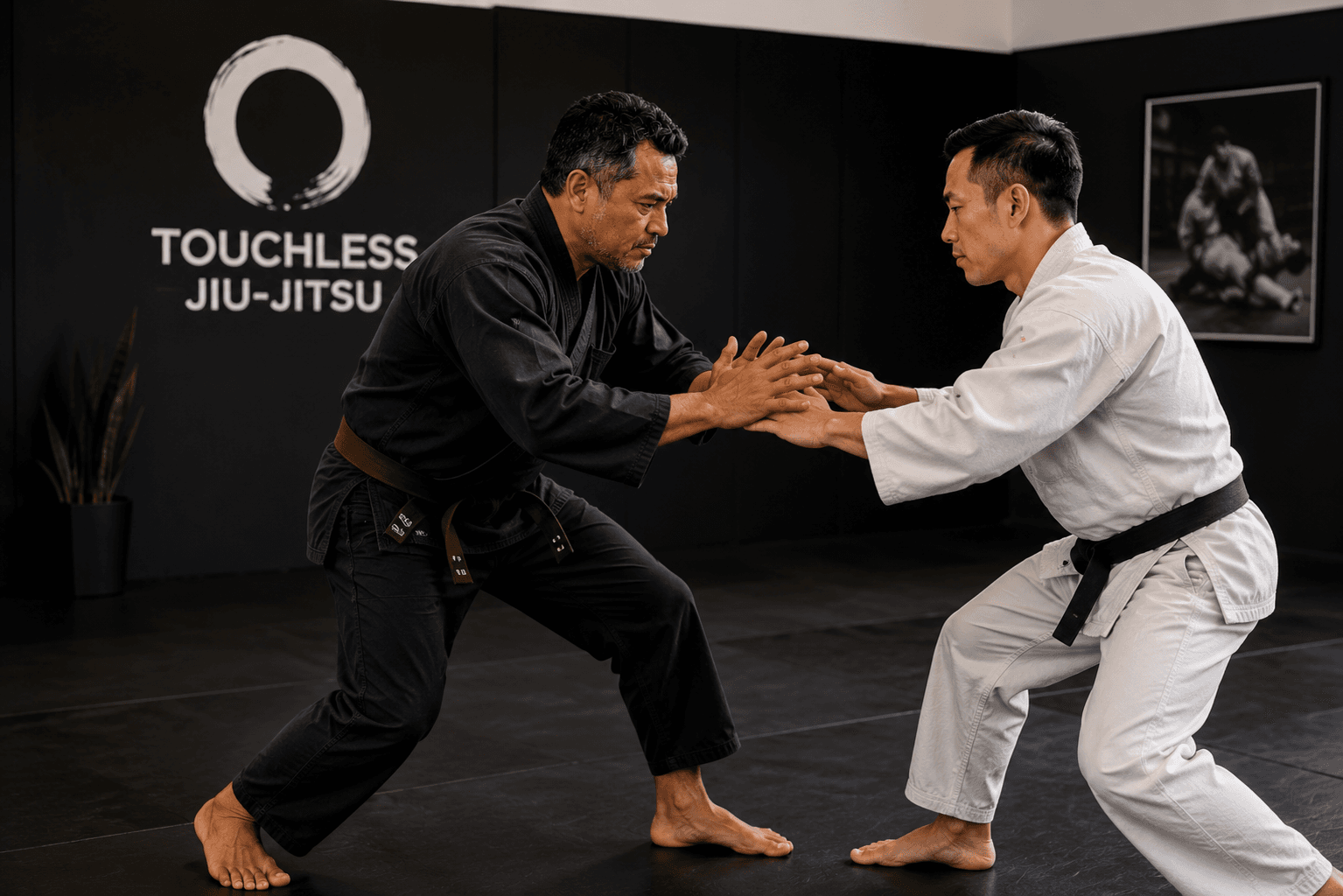
Where Touchless Jiu-Jitsu Fits
Touchless Jiu-Jitsu uses ideas from jiu-jitsu and Wing Chun differently.
The goal is not always to win a fight, finish a submission, or overpower a partner.
The same principles can be used to explore:
- Base
- Balance
- Leverage
- Pressure
- Direction
- Timing
- Rotation
- Connection
- Recovery
- Confidence near an end range
A partner provides information that a static stretch cannot.
Pressure changes.
Direction changes.
The body has to solve the problem.
In a calm drill, both people remain active and connected. The challenge stays unpredictable enough to require attention but controlled enough to remain safe.
That does not make Touchless Jiu-Jitsu a medical treatment.
It makes it a movement-education environment.
The Central Rep
Approach the wall.
Stay organized.
Use a manageable amount of load.
Notice what changes.
Leave with the body trusting the position slightly more than it did before.
What This Means for You
A stop signal can come from many places.
Sometimes the tissue is injured.
Sometimes the load is too high.
Sometimes the body lacks strength or coordination.
Sometimes the nervous system has learned to protect a pattern.
Often more than one is true.
The practical path is not to choose between body and brain.
The nervous system is part of the body.
Fascia is part of the body.
Memory is part of movement.
Load is part of learning.
The useful questions are:
- Is there a medical or structural problem that needs evaluation?
- What movement or situation triggers the brake?
- What does the person expect will happen?
- Can the movement be made smaller, slower, lighter, or more supported?
- Can strength and tolerance be rebuilt progressively?
- Can the person collect successful repetitions without forcing the issue?
The goal is not to convince someone that nothing is wrong.
The goal is to help the body gather better evidence.