What getting up off the ground actually demands
Lowering yourself to the floor and standing back up is one movement in the way that a golf swing is one movement — a single word covering a sequence that has to hold together.
You need enough hip, knee, and ankle range to fold into the bottom position. Enough strength to push out of it. Enough balance to stay over your base while your centre of mass travels a long way. Enough coordination to sequence the pieces in an order that works. And a body composition that isn’t asking those systems to move more than they can.
Any one of those failing shows up as the same thing — a hand on the floor, a knee down, a longer route. Which is why the movement is such a useful signal, and also why a low score on its own doesn’t tell you which part broke.
How people really get up
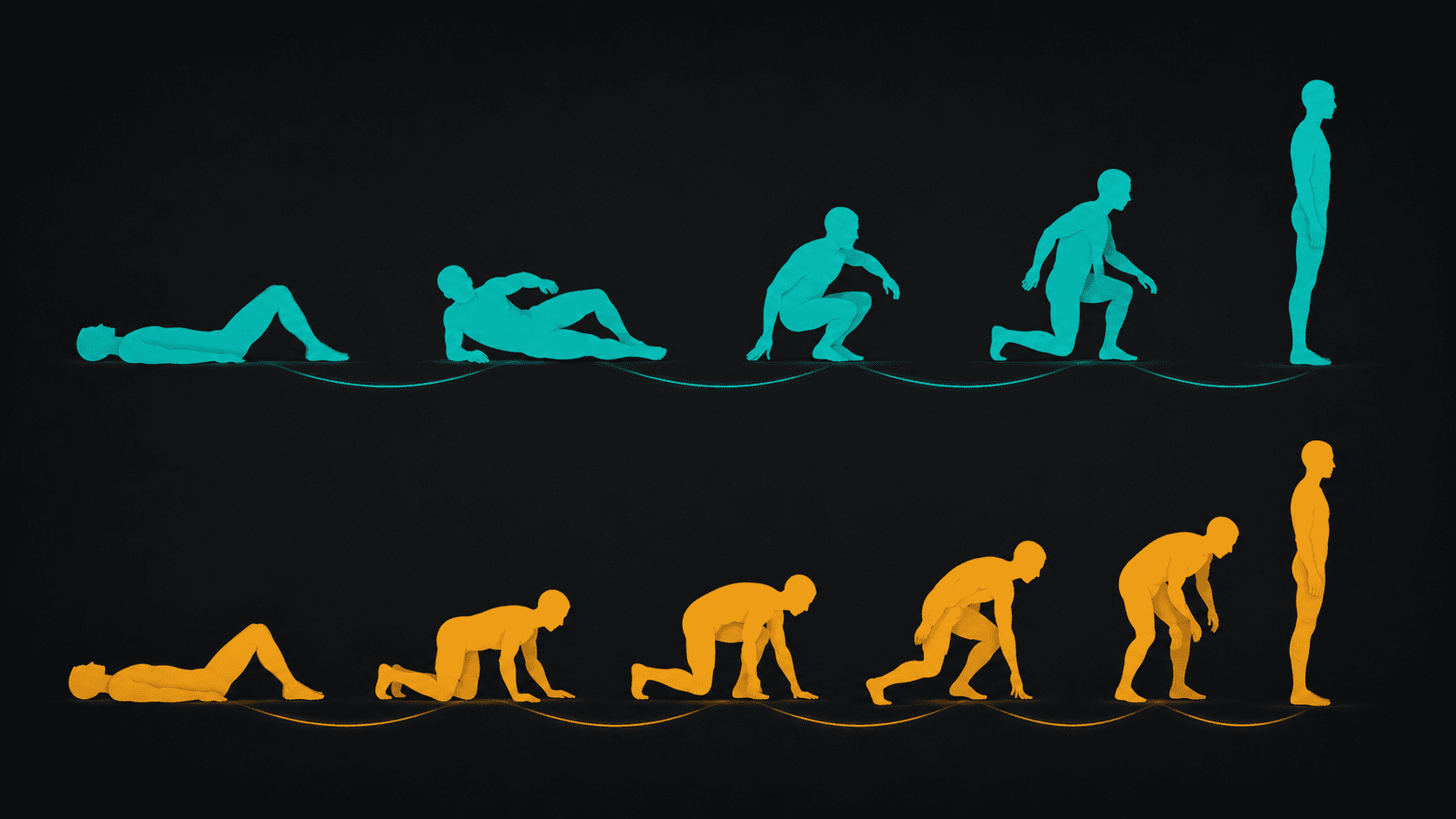
A study videotaped healthy older adults, more physically impaired older adults, and young adults rising from a supine position on the floor, and catalogued the body positions each group passed through (Body positions used by healthy and frail older adults to rise from the floor).
Healthy older adults used intermediate positions in common with young adults. The more impaired group used different ones.
That’s a specific finding worth sitting with. The difference wasn’t only that impaired people were slower or needed more support — they took a different route. Rising from the floor has multiple viable solutions, and which one your body reaches for changes as capability changes.
Is it just flexibility?
This is the question the whole topic hinges on, and it’s been studied directly.
Brito and colleagues examined whether flexibility explains the ability to sit and rise from the floor, measuring both across male and female subjects. Their conclusion was that these seemingly simple actions are partially dependent on flexibility (Does Flexibility Influence the Ability to Sit and Rise from the Floor?, American Journal of Physical Medicine & Rehabilitation, 2013).
Partially. Not wholly.
Flexibility gets the attention here because it’s the most visible thing failing — you watch someone struggle to fold into the position and reach for the obvious explanation. It’s also the easiest thing to sell, and the easiest thing to prescribe.
A separate prospective cohort found reduced body flexibility associated with poorer survival in middle-aged men and women (Scandinavian Journal of Medicine & Science in Sports, 2024), so flexibility is genuinely carrying signal. The question is what else is in there alongside it.
The nervous system half
What fails when someone can’t get off the floor often isn’t tissue length. It’s control.
Aging changes the neuromuscular system in ways that are separate from flexibility and separate from muscle size. Motor neurons are lost during normal aging, reducing the complement of motor neurons and muscle fibres (Aging of the human neuromuscular system). Work on motor unit remodelling in human limb muscles frames the everyday consequence directly: lower muscle mass, weakness, and poor coordination are common complaints in older age, and they reduce physical capabilities (Age-dependent motor unit remodelling in human limb muscles, Journal of Physiology).
Coordination is listed there as its own item, beside mass and strength — not downstream of them.
This is what the body-positions study is pointing at from the other direction. Frail adults using different intermediate positions than healthy adults is a sequencing difference. The body has stopped solving the problem the same way.
Range of motion, strength, and coordination are three separate inputs to one output. A stretching program addresses one of them.
More on how the nervous system governs what your body will let you do: Your Body Is Always Listening and When the Body Hits the Brakes
The sitting-rising test
Developed by Claudio Gil Araújo and colleagues in Brazil and introduced as an evaluation procedure in exercise and sports medicine in 1999.
The protocol: from standing, sit down on the floor. Then stand back up. You start with 5 points for going down and 5 for coming up. One point is subtracted for each support used — a hand, a forearm, a knee, the side of a leg. Half a point comes off for visible loss of balance.
Composite score runs 0 to 10.
That’s the whole test. No equipment, no timing, roughly fifteen seconds.
What’s normal for your age
Reference scores were derived from 6,141 non-athlete adults — 4,101 men — ranging from 16 to 98 years old (Sitting–rising test: sex- and age-reference scores derived from 6141 adults, European Journal of Preventive Cardiology, 2020; free PDF).
A perfect 10 was the most frequent score in men aged 16 to 25, and in women aged 16 to 40. Beyond 55 years old, fewer than 8% of men and women scored a 10.
That drop-off is the number worth holding onto. It isn’t that older adults score somewhat lower — a perfect score becomes rare, in more than nine out of ten people.
The mortality data
The 2014 study. 2,002 adults aged 51 to 80, 68% men, performed the test and were followed. There were 159 deaths, 7.9% of the group. Those with the lowest scores had a hazard ratio of 5.44 compared with the highest scorers, with a confidence interval of 3.1 to 9.5 (Ability to sit and rise from the floor as a predictor of all-cause mortality, European Journal of Preventive Cardiology, 2014).
The 2025 follow-up, from the same group, went further and separated causes of death. Across a larger cohort there were 665 deaths, 15.5%. Death rates by score:
- Score of 10 — 3.7%
- Score of 8 — 11.1%
- Score of 0 to 4 — 42.1%
These are observational cohorts from a single exercise medicine clinic in Rio de Janeiro. The people being tested came in for cardiopulmonary evaluation, which is not the general population.
What the test measures, and what it doesn’t
The sitting-rising test gets described three different ways in the literature, and they’re not the same claim.
As a musculoskeletal fitness screen — a quick composite of flexibility, strength, balance, and body composition. That’s what it was designed as.
As a fall-risk screen — it’s been proposed as one, and it appears in fall-assessment batteries alongside the timed up and go (Bend Don’t Break, Journal of Sport Rehabilitation).
As a mortality predictor — which is what the cohort data above supports.
A test can predict mortality without being a good screen for falls, and can screen well without the score being something you should train directly. Those are separate properties, and the popular coverage tends to collapse them.
What it doesn’t tell you is which component is failing. A 6 could be a hip range problem, a strength problem, a coordination problem, or extra body mass. The score is a signal, not a diagnosis.
Not being able to get up after a fall
This is where the topic stops being an interesting test and starts mattering.
A study of 1,103 community residents aged 72 and older in New Haven, Connecticut looked at self-reported inability to get up without help after falls that did not cause serious injury — and at what happened to those people afterward (Predictors and prognosis of inability to get up after falls among elderly persons, JAMA, 1993).
The fall itself did no serious damage. The inability to get up was the variable.
It’s a useful frame for the whole topic: most falls in a home are not catastrophic impacts. What determines the outcome is frequently what happens in the minutes and hours after.
Fear of falling
Fear of falling is a major health problem among older people living in communities, and it’s present both in people who have fallen and in people who never have (Fear of falling: measurement strategy, prevalence, risk factors and consequences among older persons, Age and Ageing).
That second half is the interesting part. The fear doesn’t require the event.
Fear and floor-rising ability have been examined together directly (Study of the relationship between fear of falling and ability to sit on and rise from the floor in elderly populations, International Journal of Physiotherapy and Research, 2019).
Fear also changes the movement itself — a person who expects to struggle moves differently before anything has gone wrong, which is the same protective pattern that shows up across the body.
Related: When the Body Hits the Brakes
Body weight
The score is a ratio: capability against what you’re moving. Excess body weight and its influence on sitting-rising test performance has been examined as its own question (Sitting-rising test: influence of excess body weight in adults, Revista Brasileira de Medicina do Esporte, 2001).
Worth naming plainly because it’s a component people often leave out of the flexibility-versus-strength argument entirely.
Conditions that change the picture
Parkinson’s disease. Twenty community-dwelling older adults with Parkinson’s, mean age 74.8, performed a standardized floor rise. Fall prevention in this population has been studied heavily; the ability to get back up considerably less so (Rising From the Floor in Persons With Parkinson’s Disease).
Multiple sclerosis. The sitting-rising test has been assessed for reproducibility and convergent validity in people with MS (Archives of Physical Medicine and Rehabilitation, 2021).
Stroke. A sitting and rising test has been evaluated for assessing people with chronic stroke (Journal of Physical Therapy Science, 2016).
After knee replacement. Validity and responsiveness of the floor sitting-rising test has been studied in a post-total knee arthroplasty cohort (Archives of Physical Medicine and Rehabilitation, 2020).
The test travels across populations, which is part of why it’s spread.
Backward chaining
The named method for teaching people to get up off the floor. You learn the sequence in reverse — starting from the position closest to standing and working backward toward lying flat, so every stage ends somewhere you already know how to finish from.
It’s been examined specifically for whether training older fallers this way prevents the complications of falls (Is there a benefit to training older fallers using the backward chaining method to prevent complications of falls?).
The logic is that getting up from the floor is a skill, not only a capacity — and skills are taught in an order.
Stretching
A study tested whether a stretching program would improve scores across a battery of fall-assessment tools in older adults, including the sitting-rising test and the timed up and go (Bend Don’t Break: Stretching Improves Scores on a Battery of Fall Assessment Tools in Older Adults, Journal of Sport Rehabilitation).
Separately, a randomized controlled trial of hip and ankle stretching performed in participants’ own homes measured effects on gait function in older people (The effects of hip and ankle stretching on gait function of older people).
Strength, and specifically power
There’s a distinction here that matters more than it sounds.
Strength is how much force you can produce. Power is how fast you can produce it. Getting off the floor is closer to a power task — a burst that moves your mass through a long range quickly enough to carry momentum through the sticking points.
Muscle power has been found to outperform strength as a predictor of mortality in middle-aged and older men and women (Mayo Clinic Proceedings, 2025).
The sit-to-stand muscle power test exists as an inexpensive, portable way to assess power in older people (commentary), and sit-to-stand scores have been related to the force-generating capacity of knee extensor muscles (Sit-to-stand test to evaluate knee extensor muscle size and strength in the elderly).
Ground familiarity
Everything above measures getting up. Almost none of it measures being down there — how often you’re on the floor, how comfortable you are once you’re there, whether the positions are familiar or foreign.
That’s a gap in the research rather than an answered question. Researchers measure tests, and floor time is a practice, not a test.
The closest thing to evidence on this comes from the floor-sitting section below, and from the observation running through the body-positions study: the people who move well down there are moving through patterns they already know.
Shane’s article on being comfortable on the ground — thirty years of teaching it — goes deeper into what this actually looks like in practice: [link to be added]
Cultures that sit on the floor
A floor-sitting movement analysis tool was developed and used to study how age and activity affect floor-sitting in Indian adults. The activity significantly increased the time taken to rise from floor-sitting (Using the Newly Developed Floor-Sitting Movement Analysis Proforma to Study the Effect of Age and Activity on Floor-Sitting in Indian Adults).
Populations where floor-sitting is a daily habit — for eating, praying, socialising — are running a continuous version of the experiment. Their relationship to the ground isn’t a test performed once a year; it’s the default posture several times a day.
There isn’t a body of comparative research measuring whether that habit protects the capacity long-term. It’s one of the more obvious open questions in this space.

The other fifteen-second tests
The sitting-rising test sits in a family of very short physical measures that turn out to predict mortality, and the same research group is behind several of them.
Standing on one leg for ten seconds. Successful performance predicts survival in middle-aged and older individuals (British Journal of Sports Medicine, 2022).
Grip strength. Inversely associated with fatal cardiovascular and all-cause mortality events (Annals of Medicine, 2020). We have a whole article on this: What Your Hands Are Telling You
Push-up capacity. Associated with future cardiovascular events among active adult men (JAMA Network Open, 2019).
Timed up and go. Predicts all-cause mortality in older men and women over 11.8 years of follow-up in the Tromsø study (BMC Geriatrics).
Balance. Balance ability and all-cause death examined in a prospective cohort of middle-aged and older adults (PMC).
A reasonable reading is that these tests are all catching some shared underlying thing, and each is a different window onto it.
Testing yourself
Firm surface, not carpet over padding. Barefoot or flat shoes. Nothing within grabbing distance that would tempt a hand out.
From standing, cross one foot in front of the other and lower yourself to sitting, cross-legged, without using anything. Then stand back up the same way.
Start at 5 for going down and 5 for coming up. Take one point off for each hand, forearm, knee, or side of leg that touches down as support. Take half a point off for an obvious wobble.
The composite is what the reference scores above are built on, so you can place yourself against 6,141 people.
Two things worth watching that the score won’t capture: which route you took, and where in the movement you got stuck. Someone who gets stuck at the bottom has a different problem from someone who gets stuck halfway up, and both score the same.