What balance actually is
Standing upright and staying there is not one thing. It’s three systems running simultaneously, cross-checking each other, and adjusting constantly.
Vision tells the brain where the body is relative to the environment. Eyes open, the brain uses what it sees to confirm and correct its sense of position. Eyes closed, that input disappears and the other two systems carry more weight.
The vestibular system— the inner ear — detects motion, tilt, and head position. It’s the system that knows you’ve moved before your muscles have finished responding.
Proprioceptionis the body’s internal position sense — nerve endings in joints, muscles and tendons that tell the brain where each body part is without having to look. It’s what lets you walk in the dark without thinking about where your feet are.
The brain takes input from all three simultaneously, weighs them, and issues constant micro-corrections to keep you upright. When one signal is absent or unreliable, the others compensate. When two are compromised, the third isn’t enough. (visual, vestibular and somatosensory contributions to balance, Peterka 2002)
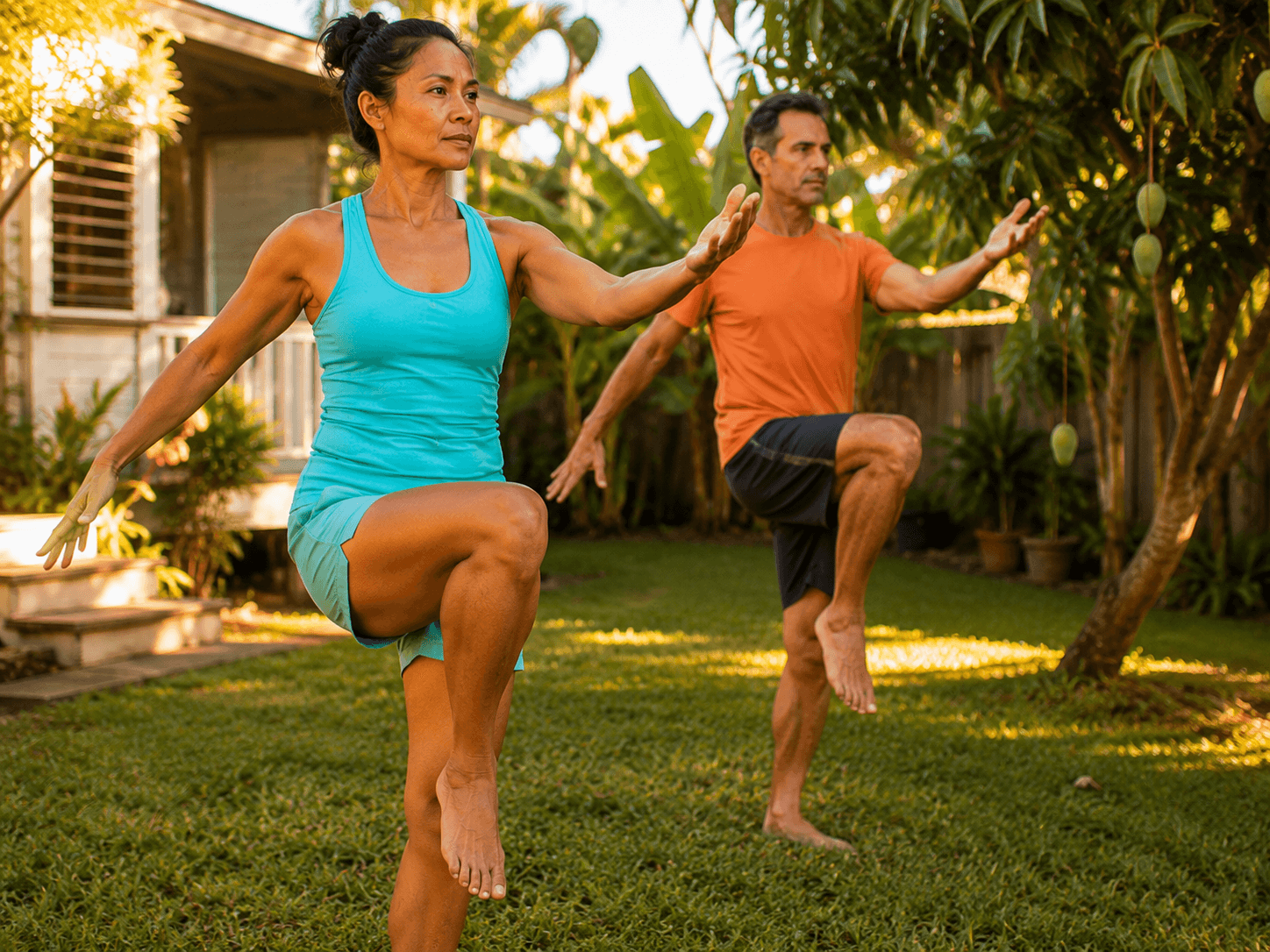
That integration is what you’re actually testing when you stand on one leg. Eyes open, all three systems contribute. Eyes closed, vision drops out and you’re running on two. The difference between your eyes-open and eyes-closed times tells you something about how much you’re relying on vision to hold yourself up — and how prepared you are for the moments when you can’t use it.
When it starts to go
Balance peaks around age 30. From there the decline is gradual until about the mid-50s, when it accelerates. (age-related changes in balance, Japanese cohort study across lifespan)
The normative data tells the story clearly. Adults in their 40s can typically hold a single-leg stance for close to 30 seconds with eyes open. By the 60s that drops to around 22 seconds. By the 70s it’s down to around 14. (normative single limb stance data, multi-age study)
Eyes closed is where the drop becomes obvious earlier. The ability to balance with eyes closed begins declining in the late 20s, because proprioception and vestibular sensitivity start fading before vision compensation can fully mask it. A person in their 50s with perfectly normal balance by everyday standards may hold an eyes-closed single-leg stance for only 3–5 seconds — and not know that’s a signal until someone measures it.
The speed of the decline after 55 matters because it catches people by surprise. They weren’t paying attention to balance because it wasn’t a problem, and then it is. Unlike strength — which people notice because things they used to carry feel heavy — balance doesn’t announce itself until it fails. And when it fails, it fails on a floor.
Why it matters beyond falling
Falls are the obvious concern. Impaired one-leg balance was the strongest individual predictor of injurious falls — not all falls, but the ones that send people to the hospital — in a 3-year longitudinal study of 316 community-dwelling adults over 60. The relative risk was 2.13 for those who couldn’t stand on one leg for 5 seconds. (Vellas et al., JAGS 1997)
But the bigger finding came from the CLINIMEX Exercise cohort in 2022 — 1,702 adults aged 51–75, followed for a median of 7 years. 20.4% of participants couldn’t complete a 10-second one-legged stance. Among those who couldn’t, 17.5% died during follow-up. Among those who could, 4.6% died. After adjusting for age, sex, BMI and other clinical data, inability to complete the 10-second test was independently associated with an 84% higher risk of death from any cause. (Araújo et al., British Journal of Sports Medicine 2022)
That paper got attention because the number is stark and the test is simple. One leg, ten seconds, eyes open. It’s not predicting the most fit — it’s distinguishing the people who have a basic functional reserve from the ones who don’t.
Why would balance predict mortality when it seems unrelated to heart disease or cancer? Because balance is downstream of multiple systems. Good single-leg balance requires intact proprioception, functional vestibular input, adequate leg strength, core stability, and the neurological wiring to integrate them all. When that integration is failing, it’s often a systemic signal, not just a balance signal.
Note on the British birth cohort: a separate 15-year follow-up study found that one-legged balance had limited prognostic accuracy in predicting recurrentfalls specifically — the AUC was poor, and the authors questioned whether it belongs in fall-screening tools. (PMC9869374) The mortality finding and the fall-prediction finding are about different things. The 10-second test is a useful mortality screen. It is not the only thing you’d use to predict fall risk in an individual.
How to test it
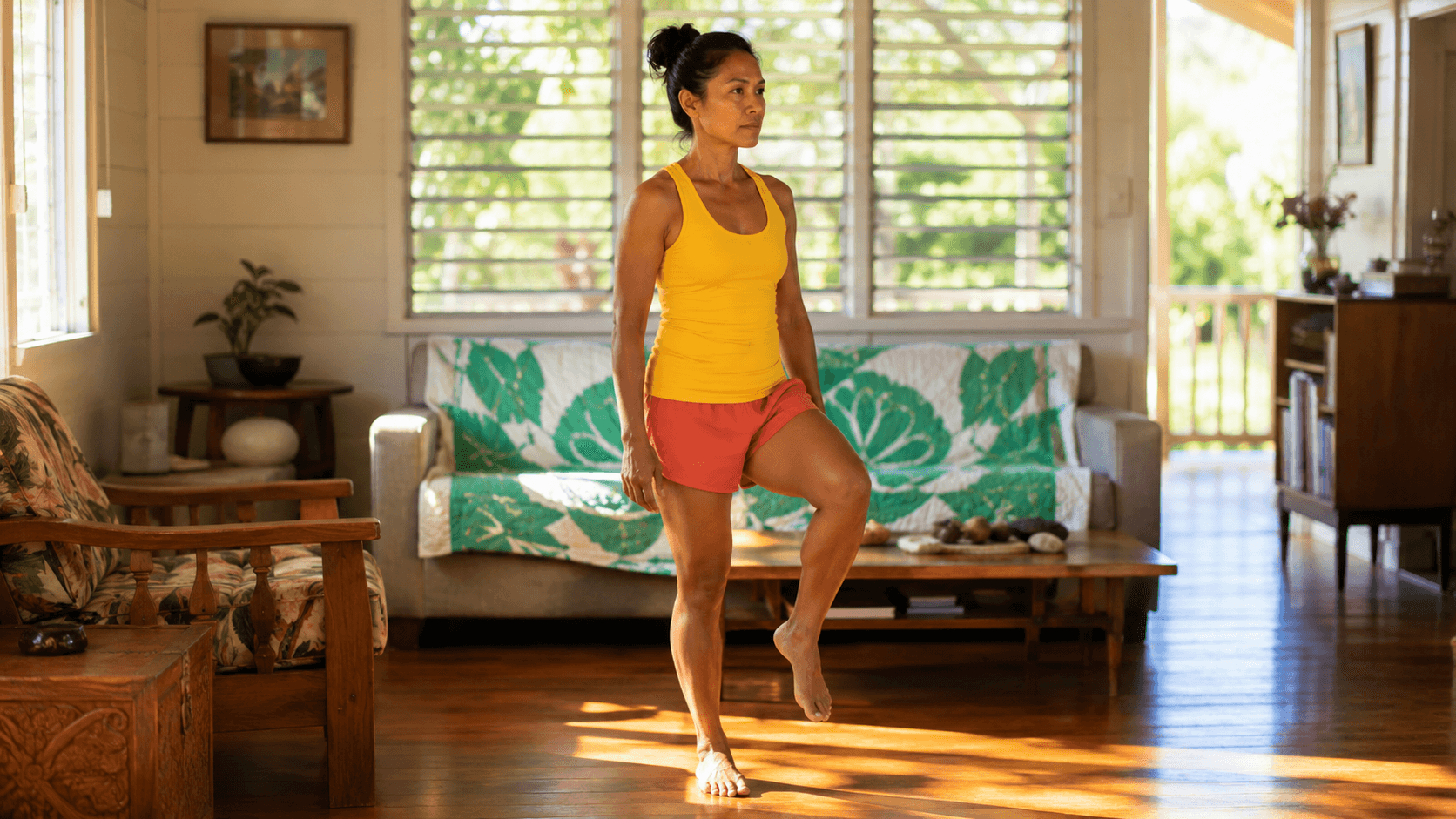
Stand near a wall or a counter — close enough to grab it if needed, but not touching it. Hands on your hips.
Lift one foot a few inches off the floor. Start timing when the foot leaves the ground. Stop timing when the foot touches back down, when a hand leaves a hip, or when you have to grab the wall. Do each leg once.
That’s the test. Eyes open, flat floor, no shoes is the standard protocol. Shoes are acceptable if that’s how you normally move.
Then do it with eyes closed.Same position, same timing rules. The eyes-closed version isn’t a separate test — it’s the second half of the same picture.
Write down four numbers: left leg eyes open, right leg eyes open, left leg eyes closed, right leg eyes closed. Note the date.
(Protocol per single-leg stance standard)
What the numbers mean
Eyes open — average by age (normative values, Springer et al. 2007, n=549)
| Age | Average (seconds) |
|---|---|
| 40–49 | ~29 |
| 50–59 | ~29 |
| 60–69 | ~22 |
| 70–79 | ~14 |
Eyes open — meta-analysis averages for older adults (22 studies, 3,484 participants ages 60–99)
| Age group | Mean (seconds) |
|---|---|
| 60–69 | 27 |
| 70–79 | 17 |
| 80–99 | 8.5 |
Two thresholds that come up repeatedly in the research
Under 10 seconds
Independently associated with 84% higher all-cause mortality risk in the CLINIMEX cohort. (Araújo et al., BJSM 2022)
Under 5 seconds
Associated with elevated risk of injurious falls. (Vellas et al., JAGS 1997)
Eyes closed — what to know:Healthy young adults can hold this 20–30 seconds. By the 50s and 60s, normal is often 3–10 seconds. This number drops faster and earlier than eyes-open because it strips out the visual compensation. A large gap between your eyes-open and eyes-closed times means your balance is heavily vision-dependent — which matters most in low-light, uneven ground, and recovery from a stumble.
If you’re under 50 and can’t hold 30 seconds eyes open, that’s worth paying attention to. If you’re over 60 and can’t hold 10 seconds eyes open, that’s the threshold the research flags.
What improves it
Balance responds to training — consistently, across age groups, and faster than most people expect.
Tai chi has the strongest research base. In a randomized controlled trial comparing tai chi, balance training, and yoga in older adults who had fallen, all three improved balance, with tai chi producing the largest gains. (Ni et al., 2014) Long-term tai chi maintenance preserved significant gains at 6-month follow-up. (Wolf et al., 1996)
The mechanism isn’t mysterious. Balance training works by challenging the system — making the three input channels work without full support from each other. Standing on one leg is balance training. Closing your eyes while standing is balance training. Walking heel-to-toe is balance training. Any activity that requires the body to maintain upright position without a stable base is practicing the exact skill being measured.
The most direct way to improve single-leg balance is to practice single-leg balance. Start near the counter, hold as long as you can, rest, repeat. Eyes open first, then eyes closed as eyes-open improves. Both legs.
Progressive overload applies here the same way it applies to strength. Start where you are. Add challenge slowly — less counter support, eyes closed, standing on a folded towel. The nervous system adapts.
What doesn’t work is waiting. Balance doesn’t maintain itself through ordinary daily activity the way cardiovascular fitness somewhat does. It requires deliberate challenge to stay sharp, and the window to maintain it is open much longer than the window to recover it.
How it connects to the other tests
The five tests in The Mark on the Wall are five windows into the same underlying system.
Balance is the coordination layer. Walk speed is the integration output. Sit-to-stand is the power that makes movement possible. Getting up off the ground is the floor-level version of all of it. Grip is the systemic strength readout.
A person who has good walk speed but poor balance is at higher injury risk than their gait suggests — they can move well until they can’t, and then they can’t catch themselves. A person who has good balance but poor walk speed is protecting function they can rebuild on. The sequence those tests fail in tells you something about which system is leading the decline.
Balance also has a specific relationship to getting off the floor. Ground-level transitions require the same vestibular and proprioceptive integration as single-leg stance, under a higher load and in a less familiar orientation. People who score below 10 seconds on the single-leg stand almost always struggle with ground transitions — not because of strength, but because the coordination piece that both movements require is the same piece.