

What the test actually measures
Every time you get out of a chair, your body runs a small coordinated event. Your quadriceps — the muscles across the front of your thighs — fire to push your body mass up against gravity. Your hip extensors (glutes and hamstrings) drive you to upright. Your ankles control the forward lean that gets the movement started. Your core holds everything together through the transition.
That sounds like a lot, because it is. Getting out of a chair without arm support is one of the most mechanically demanding things a healthy adult does routinely in a day — it requires both strength and the ability to produce force quickly (what researchers call power), and it engages every major muscle group in the lower body simultaneously. (quadriceps, hip extensors, ankle mechanics in sit-to-stand)
The 30-second chair stand test, developed by Rikli and Jones in 1999 and validated in 7,183 community-dwelling adults across 21 US states, counts how many full stand-and-sit cycles you can complete in thirty seconds without using your arms. (Rikli & Jones, Journal of Aging and Physical Activity 1999) It was designed specifically because traditional strength tests were too hard for older adults to complete, while the floor versions created the opposite problem. The chair stand sits in the middle: accessible enough for almost anyone to attempt, demanding enough to separate people who are losing function from people who aren’t.
The test correlates strongly with maximum leg press performance — in the original validation study, the correlation was 0.78 for men and 0.71 for women. (Rikli & Jones 1999) That means the chair and thirty seconds of your time gives you a read on lower body strength that tracks closely with what you’d measure in a gym with equipment.

Why it predicts more than leg strength
Lower body strength isn’t just about getting out of chairs. It’s what keeps you from falling, climbing stairs, carrying things, getting up off the ground, and moving through a day without holding onto things for support.
In a study of 43,605 adults aged 50 and older followed for an average of 7.3 years, 4,154 people died. Using the 5-repetition chair stand test — a different but related version that measures how long it takes to stand up five times — researchers found that slower performance was associated with higher mortality risk in a dose-response pattern. People at the 90th percentile (slowest 10%) had an 18% higher risk of death than those at the median. (Núñez-Cortés et al., Brazilian Journal of Physical Therapy 2025)
That study also found that for older women specifically, the chair stand test was more predictive of mortality than grip strength — flipping the usual finding. The researchers noted this likely reflects that lower body power matters more for functional independence in that population.
A Brazilian cohort study following older adults for 10 years found that chair stand performance was significantly associated with all-cause mortality, independent of gait speed. (functional mobility and 10-year mortality, São Paulo)
And in people with COPD — a population where physical function declines quickly — the 5-repetition sit-to-stand test was the only musculoskeletal test that independently predicted 5-year mortality after adjusting for disease severity, history of heart disease, and other factors. It showed similar discriminative ability to the 6-minute walk test. (BJPT systematic review)
Performance on sit-to-stand also predicts future falls and disability. A longitudinal study found that 5-repetition sit-to-stand performance predicted subsequent falls, fall-related fractures, and loss of ability to perform daily activities. (Tiedemann et al., 2008)
The mechanism runs both ways. Losing leg power makes it harder to get out of a chair. Being unable to get out of a chair leads to less movement, which leads to more lost leg power. The same compounding loop that runs through inactivity in general runs through this one movement specifically.
How to do it
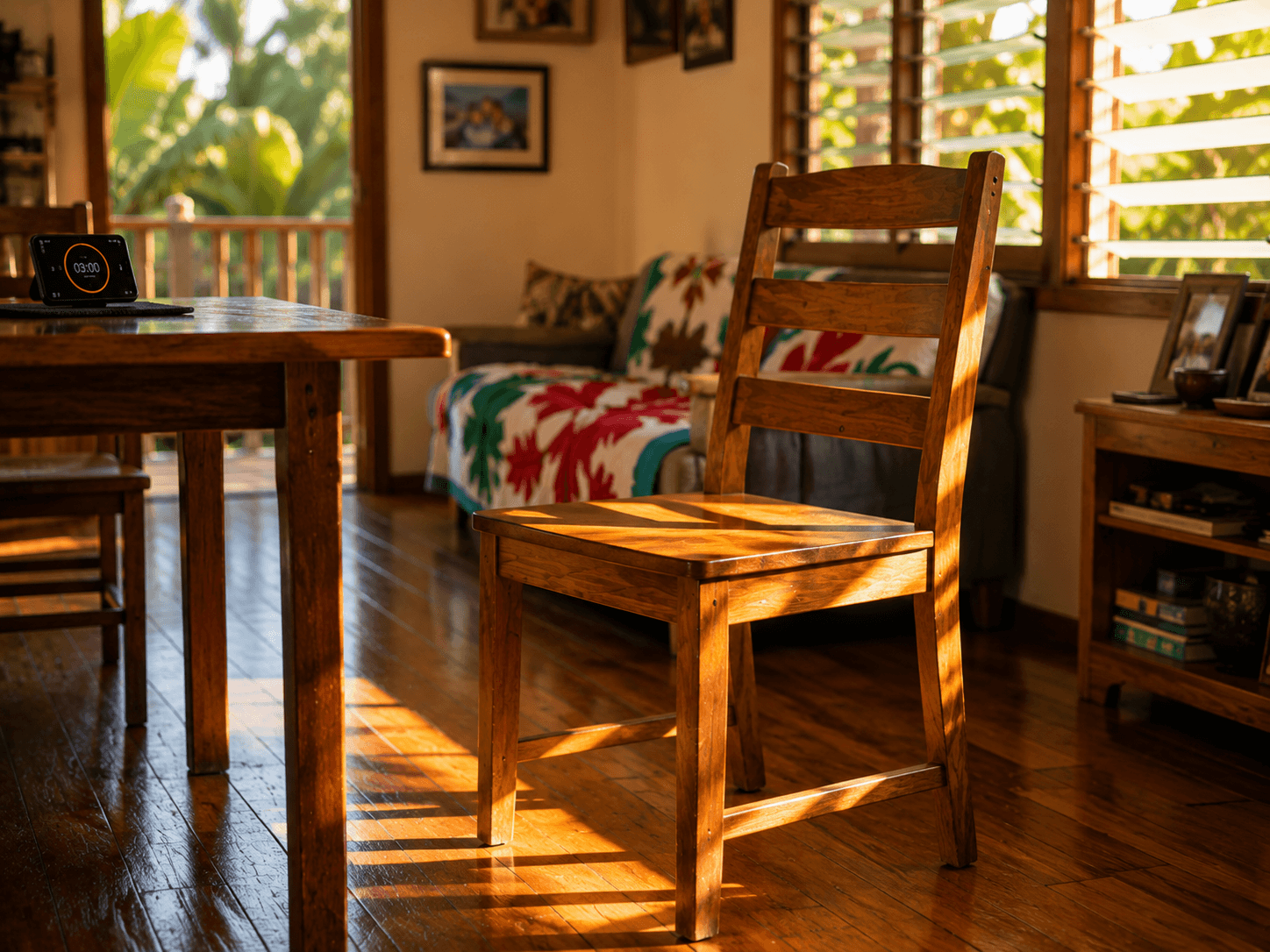
You need a sturdy chair with a seat height of about 17 inches — a standard dining chair or folding chair works. No chair with wheels.
Start seated in the middle of the chair, back straight, feet flat on the floor about shoulder-width apart. Cross your arms over your chest. The arms stay there for the whole test.
When you’re ready, start a 30-second timer and stand all the way up — fully upright — then sit all the way back down. Fully down means your weight is back on the seat, not just hovering. Count that as one repetition. Keep going until the timer runs out. Count a partial stand at the end if you’ve passed the halfway point when time runs out.
Count only complete stands where both the top (fully upright) and the bottom (fully seated) positions are reached. If you need to touch the armrests to get started, note that but do the test — it’s still useful information. (protocol per Rikli & Jones)
Write down your number and today’s date.
What the numbers mean
These are the normative ranges from Rikli and Jones’s original study of 7,183 community-dwelling US adults. The middle column is the average range — the 25th to 75th percentile. Below the low end of that range is below average for your age group.
| Men | |||
|---|---|---|---|
| Age | Below average | Average range | Above average |
| 60–64 | fewer than 14 | 14–19 | more than 19 |
| 65–69 | fewer than 12 | 12–18 | more than 18 |
| 70–74 | fewer than 12 | 12–17 | more than 17 |
| 75–79 | fewer than 11 | 11–17 | more than 17 |
| 80–84 | fewer than 10 | 10–15 | more than 15 |
| 85–89 | fewer than 8 | 8–14 | more than 14 |
| Women | |||
|---|---|---|---|
| Age | Below average | Average range | Above average |
| 60–64 | fewer than 12 | 12–17 | more than 17 |
| 65–69 | fewer than 11 | 11–16 | more than 16 |
| 70–74 | fewer than 10 | 10–15 | more than 15 |
| 75–79 | fewer than 10 | 10–15 | more than 15 |
| 80–84 | fewer than 9 | 9–14 | more than 14 |
| 85–89 | fewer than 8 | 8–13 | more than 13 |
Scores below 8 unassisted stands were associated with lower levels of functional ability in the original research. (Rikli & Jones 1999)
If you’re in your 40s or 50s and the table doesn’t cover you — there are fewer US normative studies for younger adults, but a small study of adults aged 19–35 found a mean of about 33 repetitions. (Lein et al. 2022, reported here) That gives you something to compare against, though the sample was small.
The more useful number isn’t where you rank today. It’s whether your number is going up or down year over year. A person who was doing 17 at 65 and is doing 14 at 70 needs to know that, regardless of where 14 puts them on a chart.
When you can’t do it without your hands
Using the armrests or your thighs to push off is not a failed test — it’s information. It means your leg power, at this moment, is below the threshold required to stand unassisted. (threshold of relative muscle power required to rise from a chair)
There’s a modified version of the 30-second test that allows arm use, developed specifically for older adults whose function has already declined significantly. (Modified 30-Second Sit-to-Stand, PTRS 2019) If you need to use your hands, use them, note it, and do the test. The modified version has its own reliability data and still gives you a number to track.
What matters most is that you track it over time. The number that can’t be allowed to go to zero is the ability to stand from a seated position independently — because that ability is directly tied to whether someone can live alone, get up if they fall, and move through the basic architecture of a day.

What improves it
Leg strength and leg power are both trainable at any age. The research on this is consistent enough to be stated plainly.
A 12-week combined exercise intervention in community-dwelling older adults produced a 54.7% improvement in 30-second chair stand scores — not a small gain, a fundamental change in what the body could do. (PMC3894141)
Repeated sit-to-stands done as home exercise — using the movement itself as the training, not equipment — improved performance in mobility-limited adults over 80. (Sit-to-stand as home exercise for adults over 80) You don’t need a gym. You need a chair and the intention to practice.
The mechanism is straightforward: the movement you want to get better at is a loaded version of the training. Every sit-to-stand you practice is a repetition that directly builds the strength and coordination the test measures. Doing the test IS the training, done slowly and deliberately, with control on the way down as much as the way up.
Strength training that targets the quadriceps and glutes — squats, leg press, step-ups — produces transferable gains. In a study of adults over 80, both sit-to-stand practice and progressive resistance training improved the test, with resistance training producing larger gains. (GrandStand System study)
The slower you go, the more you build. A fast, bouncy sit-to-stand test score uses momentum to compensate for strength. Deliberate, controlled repetitions in training — pausing at the bottom, lowering slowly — build the actual capacity.
How it connects to the other tests
The five tests in The Mark on the Wall are not independent measurements. They’re five windows into the same underlying system.
Walk speed tells you how well everything integrates into functional movement. The chair stand tells you specifically about lower body power — the engine that makes walking, stair-climbing, and recovery from a stumble possible. Getting up off the ground tells you about the floor-level version of the same capacity, where the demand is higher and the stakes are higher. Grip tells you about whole-body strength via the hands. Balance tells you whether the coordination layer on top of all of it is intact.
A person who scores well on walk speed but poorly on chair stand is running on reserves — their gait looks functional, but the strength underneath is going. A person who scores well on chair stand but poorly on balance has power without the control to use it safely.
Where they point together is where the picture is clearest.
The chair stand and the floor get-up are the closest relatives in the set. If the chair stand is getting hard, the floor is likely next. If the floor is already gone, the chair is where recovery starts — because you can practice it fifty times a day, right in your own home, with zero equipment.
Where to go from here
The sit-to-stand test is the second of five in the baseline assessment. If you haven’t done all five, they take about four minutes total and the starting point is worth having.
The Mark on the Wall — Take All Five Tests
The closest related deep dives on this site:
Getting Up Off the Ground covers the floor-level version of this same capacity — the sitting-rising test, what the research says about it, and what it actually takes to get back up from the floor.
Walk speed covers the movement test that summarizes whole-body function, and why a stopwatch across 13 feet carries more predictive information than most clinical measurements.